
Fields Inside Franklin County Property Tax Records
Any Franklin County tax inquiry crosses assessment, calculation, and collection records that link to one another. Label the source and the year whenever you save a number.
| Record field | What it explains | Primary source |
|---|---|---|
| Land and improvements | Components of gross assessment | Assessor or Auditor |
| Deductions and exemptions | Qualified reductions or exempt treatment | Auditor |
| Taxable assessment | Amount remaining for tax calculation | Auditor |
| Rates and taxing units | District charges applied to the parcel | Auditor or Treasurer |
| Installments and payments | Amounts billed, credited, due, or delinquent | Treasurer |
Owner labels are not proof of title. A blank sale-price field proves nothing about deeds, either. For the recorded conveyance itself, turn to Franklin County deed records, which carry the instrument that actually transferred the parcel.
Four Search Routes Into Franklin Tax Records
The Franklin County public property search offers owner, address, parcel, and advanced modes. Each mode rewards a different input habit. The address form splits house number, direction, street name, and type. It suggests trying a street name without its suffix. Owner searches narrow by tax district and property type. Parcel searches work best with punctuation and leading zeros preserved.
| Route | Best input | Confirm against |
|---|---|---|
| Address | House number and street name | Tax district |
| Owner | Surname or exact entity name | Situs and acreage |
| Parcel | Complete identifier | Legal description |
| Advanced | Several criteria | Property type |
The official address form captured below shows those separate fields.
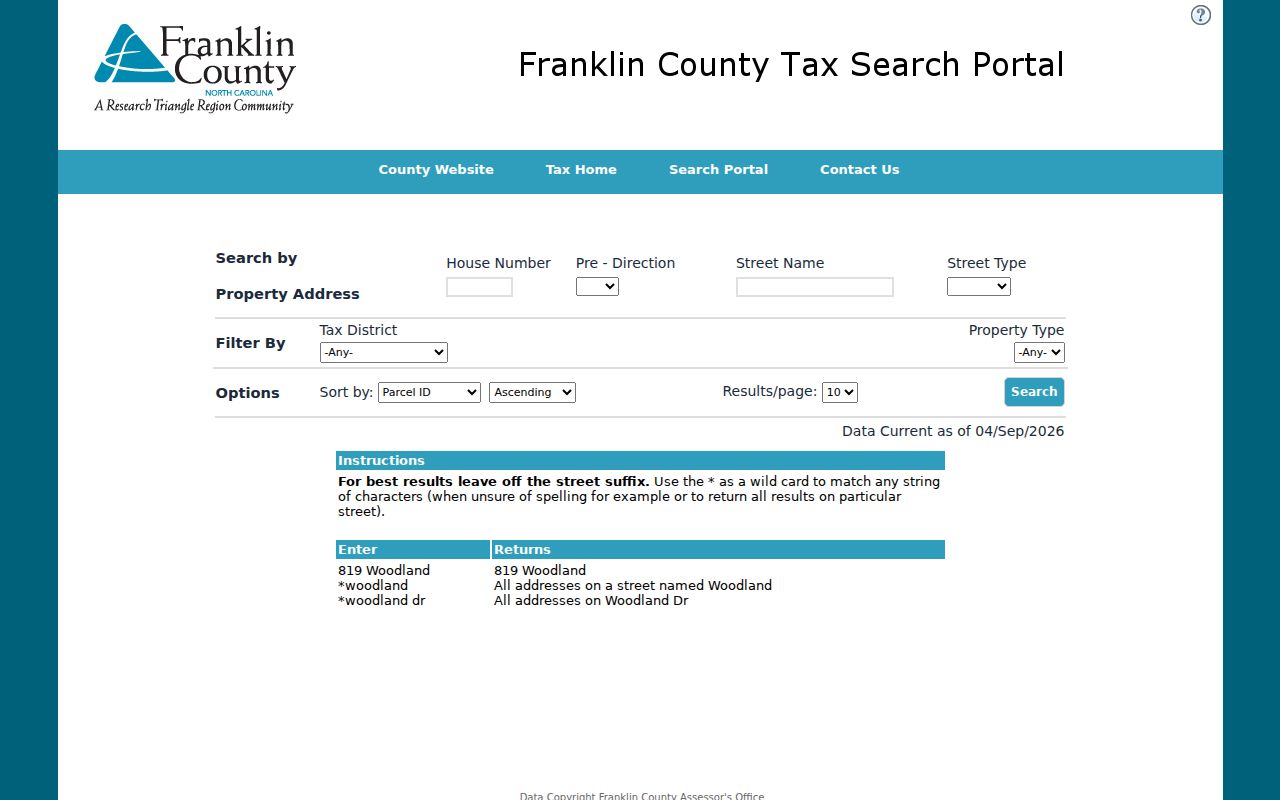
The form's wildcard and no-suffix guidance is especially helpful when a rural address or street designation has changed. It also spares you from guessing how the county spelled a road name years ago.
Look Up a Franklin County Tax Bill
The parcel number is the bridge between the assessment and payment systems, and it sidestps owner-name variations and mailing-city ambiguity. Use it whenever possible.
- Locate the parcel in the county search and record its identifier, tax district, value components, legal description, and data date.
- Open the county tax collector search or Treasurer list, choose the correct roll or year, and match the parcel.
- Read installments, payments, charges, balances, and taxing units. Keep tax year and payable year distinct.
- Compare Auditor deductions and taxable value. If delinquent, check the current Treasurer notice before drawing any sale conclusion.
- Assessed value
- Value assigned under Indiana's assessment system before deductions.
- Taxable assessment
- The amount remaining for tax calculation after applicable deductions.
- Levy or rate
- The taxing-unit charge applied within the parcel's district.
- Tax lien
- A claim arising from unpaid tax; later payment, sale, redemption, and deed records still matter.
Note: A payment-service convenience fee is separate from the property tax itself and is described as nonrefundable.
Franklin Tax Year and Pay Year Differ
Watch the tax year and pay year on any Franklin County figure. The Auditor sample covers tax year 2023 payable 2024, so it cannot be quoted as a current 2026 value. The Treasurer separately published 2025 payable 2026 installment information. State both years whenever copying figures into a comparison or appeal file.
The public search showed a September 4, 2026 update, the owner form an August 28, 2026 data date, and the Treasurer list September 6, 2026. These timestamps identify portal snapshots, not when a deed, deduction, or payment legally took effect.
The county search home below preserves its update and disclaimer context.
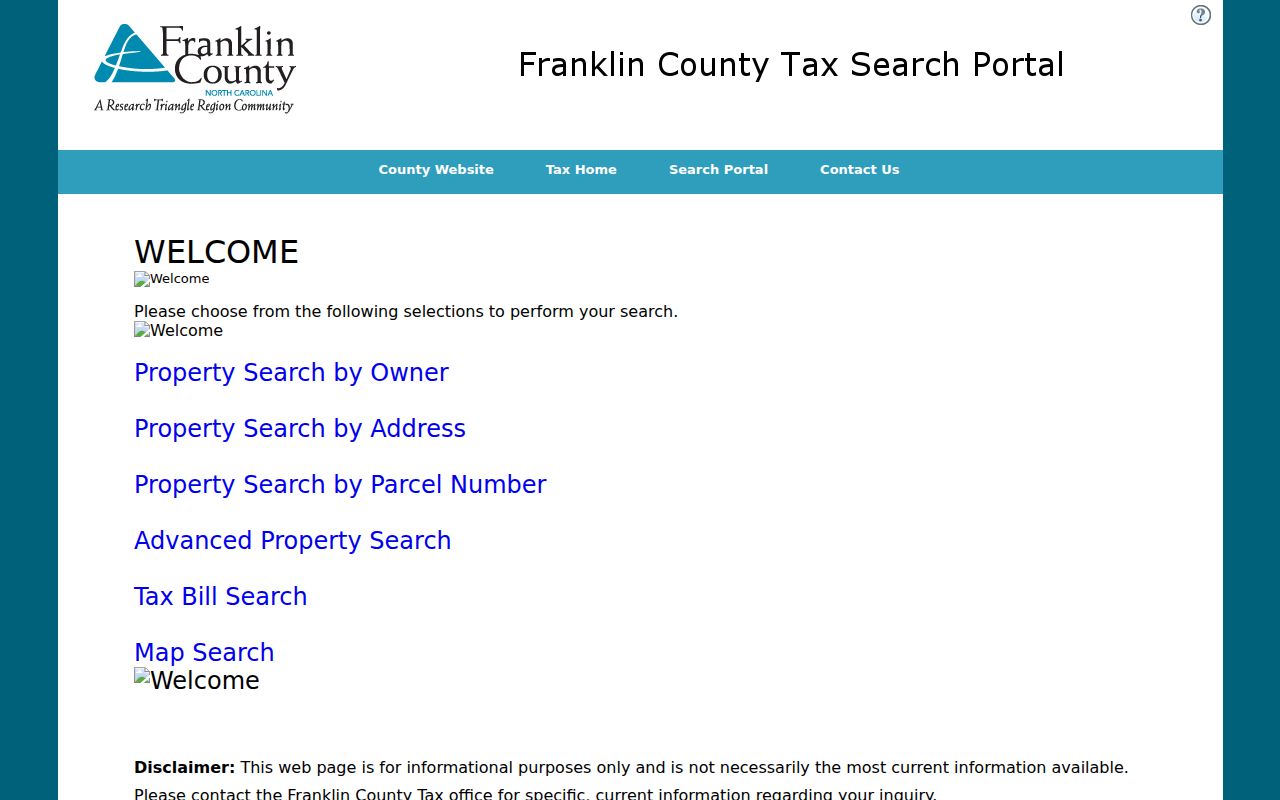
Save the visible date beside the result. That habit lets you tell a later Franklin County update apart from a transcription problem of your own.
Indiana's 100 Percent Assessment Framework
Indiana assesses under a 100 percent framework, using true tax value and market value-in-use terms. That ratio is a legal standard. It does not make an assessment identical to a private appraisal, an asking price, or one sale amount. The DLGF property-tax glossary supplies the terms. The Franklin parcel card supplies the local figures. Land, improvement, gross assessment, TIF assessment, deductions, and taxable assessment each answer a different question, so read the calculation in sequence. Even exempt property keeps acreage, legal-description, and transfer data. Comparing years demands care. Separate a genuine valuation change from a deduction change, a district-rate change, a parcel split, a new improvement, or a correction to characteristics. A higher bill can hide several causes. Save the calculation lines for both years and identify which input changed before drafting an appeal argument.
Franklin Deductions and Exemptions Alter Taxable Value
Indiana separates deductions and credits from exemptions. The DLGF deductions page lists the common programs and routes filing through the county Auditor. The state exemptions page covers applications and forms. Confirm eligibility, deadlines, and refiling rules for the current year. On the tax record itself, compare the benefit names and amounts actually displayed. A missing line has several explanations. The viewed year may predate approval. A filing may be pending, or eligibility may not apply. A separate record may need checking. So never infer eligibility from an owner name or apparent property use.
Reconcile Franklin Gross and Taxable Assessment
Start with the land and improvement figures. Add them to verify the displayed gross assessment. Then identify each deduction or exempt component before comparing the taxable result. TIF assessment sits in its own field in the county sample and is not a second market estimate. The district rate applies last. That order pinpoints the disagreement. Comparing two years works the same way. Place the fields side by side rather than comparing bills alone, since a bill can change because of assessment, deductions, credits, taxing-unit rates, district boundaries, or prior balances. Preserve the tax district, township, school district, assessment year, payable year, and portal update date. A blank field is not zero. Ask the responsible office instead of treating the empty space as a figure.
Appeal a Franklin County Assessment With Form 130
An appeal begins at the Assessor's office. Indiana's Form 11 guidance explains the notice that changed the value. The DLGF appeal page describes informal review. It also covers the Property Tax Assessment Board of Appeals route. Form 130 opens the written appeal. Evidence can include the parcel card, photographs, and corrected building facts. Land classification, carefully selected sales, a survey, an appraisal, or a calculation showing factual error also work. Keep the notice date. Filing time follows the statutory notice or assessment calendar, not one permanent annual date.
Protect the appeal window. Verify the current filing deadline with the Franklin County Assessor, submit Form 130 on time, and retain delivery proof.
Franklin's 2025 Ratio Study and 2026 Cycle
DLGF's statewide schedule calls for a new cyclical reassessment beginning July 1, 2026. It affects 2026 pay-2027 taxes. Physical inspection will cover roughly 25 percent of parcels per year over four years. Preserve any inspection or assessment notice you receive. It can explain changed characteristics on your Franklin County property record.
The March 26, 2025 Franklin County ratio-study approval examined several measures. These included sales chasing, vertical equity, the median ratio, the coefficient of dispersion, the price-related differential, and change analysis. DLGF noted that it did not verify every sales-disclosure form. A countywide approval evaluates the study itself, not the accuracy of every parcel.
Physical inspection and annual adjustment are related but different concepts. Inspection reviews property characteristics on a rotating schedule. Annual work may adjust values using market evidence instead. For a Franklin County parcel, compare the prior and current property record cards line by line, then ask the Assessor which process produced the change. That question is more precise than relying on a countywide news item.
Franklin Tax Sale Has Distinct Legal Stages
A delinquent balance is a dated status. It does not prove that ownership changed. Franklin County's 2025 notice set an October 28, 2025 sale. It also described registration, judgment defenses, redemption percentages, and possible surplus rights. Those dates will not repeat. The Treasurer page lists the 2026 sale date as TBA, so any future search must rely on a new notice.
Follow the sequence from tax-list entry through judgment and notice, sale result, certificate, redemption or assignment, and any later tax deed. Search Recorder and court records when the matter continues beyond billing, because a parcel may be redeemed, a sale may not occur, or a dispute may alter the result.
Delinquency is not a transfer. Only the later statutory and recorded trail establishes whether a tax-sale process changed title.
Use the Franklin Office That Owns the Question
Franklin County splits tax duties across offices. The Assessor owns property characteristics, classification, gross assessment, and the basis for value. The Auditor owns deductions, exemptions, taxable assessment, transfer administration, and tax-roll calculations. The Treasurer handles installments, posting, balances, and collection. Ask there about current tax-sale notices too. A Recorder deed can confirm the conveyed interest. A Clerk docket can clarify litigation. Neither one replaces a tax office's own certified record.
For an offline request, provide the parcel number, the owner or taxpayer name as displayed, the property address, the tax and payable years, and the precise field you need. Indiana's Access to Public Records Act supports inspection and copying of existing public records, but no agency has to create a new analysis. A focused request for a card, ledger, notice, or filed form therefore works better than asking an office to calculate a conclusion.