
What Franklin County Deed Records Document
A deed moves an interest in real estate. It passes from one party to another. The Franklin County Recorder indexes deeds alongside a whole family of related filings. They all share one index. So you can connect a conveyance to the corrections, affidavits, mortgages, releases, surveys, plats, and liens that came after it. The recorded document controls. An index entry is only a pointer.
| Deed type | Effect shown by the instrument | Typical record question |
|---|---|---|
| Warranty deed | Conveys the stated interest with warranties written into the deed | Ordinary purchase and sale |
| Quitclaim deed | Conveys whatever interest the grantor holds without broad warranties | Family transfer or title cleanup |
| Correction deed | Corrects an error in an earlier instrument | Name or legal-description repair |
| Personal-representative or trustee deed | Transfers through an estate or trust authority | Probate or fiduciary conveyance |
| Sheriff or tax deed | Records a transfer following the applicable sale process | Distressed-property history |
Not every instrument works like a deed. A mortgage, mechanics lien, federal tax lien, sewer lien, or easement can burden or benefit the land without transferring fee ownership. Before assuming an older encumbrance still matters, search forward for assignments, satisfactions, releases, modifications, or a court disposition.
Franklin County Recorder Is the Instrument Custodian
The Recorder's office sits at 459 Main Street in Brookville. Its published coverage reaches back to 1810. Not everything from those early decades is online, though. The office records deeds, mortgages, assignments, releases, powers of attorney, contracts, annexations, affidavits, and final decrees. It also holds surveys, subdivision plats, federal tax liens, mechanics liens, cemetery deeds, condominiums, and sewer liens.
Start with the online tools. Contact the office when an image, an old volume, or a certified copy is missing. The Recorder does not perform definitive title searches or give legal advice. When you write, include names, approximate dates, the document type, and a parcel or tax ID. Add any book/page or instrument reference already in hand. A focused request works far better than asking staff to figure out who owns a parcel.
Note: The Recorder index is a finding aid. The complete image and later instruments supply the meaning.
Franklin Deed Index Coverage Begins Online in 1940
Online deed coverage in Franklin County reaches back to 1940. The other ranges start later. Mortgages begin in 1990, easements and miscellaneous instruments in 1980, and surveys in 2002. Every document has been scanned since 2001, and microfilm holds the older archival material. These dates mark access boundaries. They do not mean earlier interests never existed.
The Doxpop recorded-document search is the online route. Search both sides of the transaction. Vary names, initials, trustees, estates, and spellings when a match stalls. Doxpop may show an index entry without a free image. An online image is still not a Recorder-certified copy.
The Doxpop search page displays the live lookup screen. It covers deed records and the other indexed instruments.
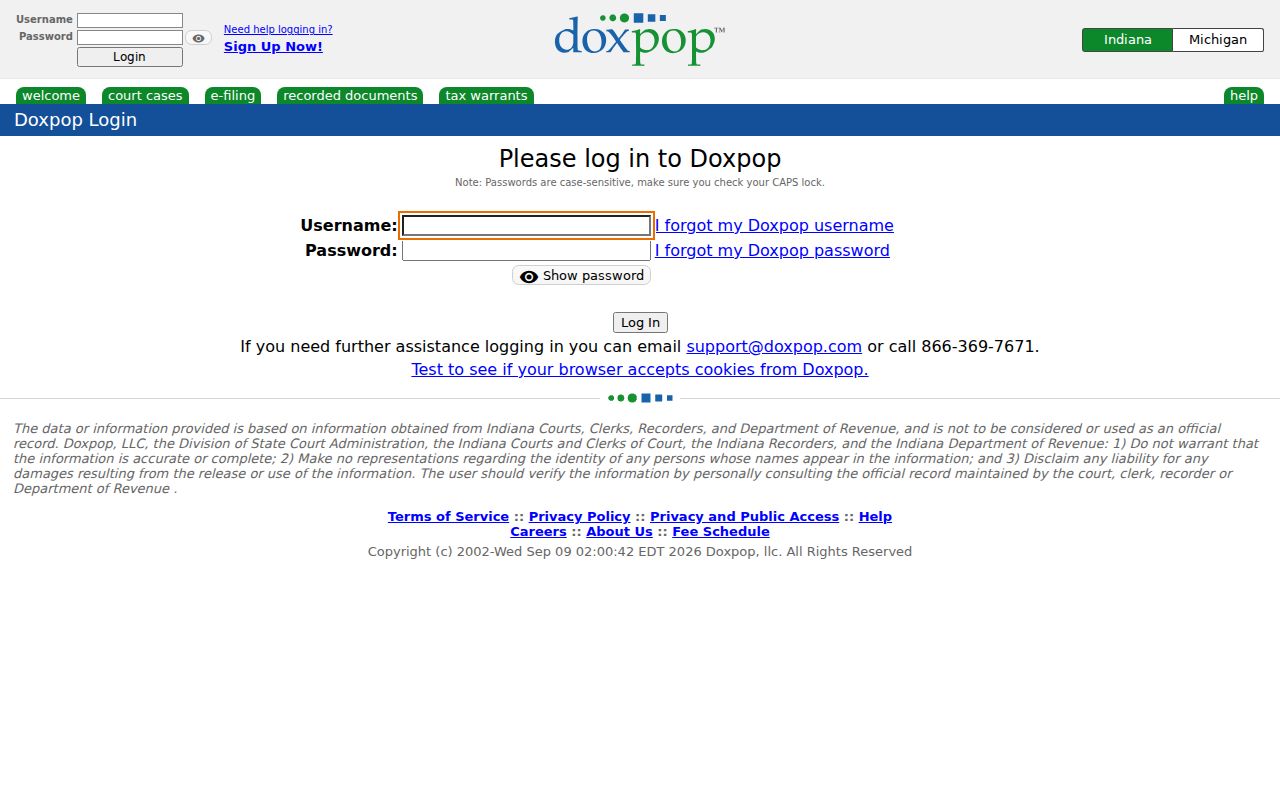
The Doxpop portal confirms the online route, while the county's stated cutoffs and the Recorder's office guide any material that falls outside the indexed range.
Walk Franklin County's Grantor-Grantee Chain
Franklin County deed records are traced person by person. Start with a known current owner, ideally from a dated assessor result. But confirm the legal description and parcel number before stepping into the deed index.
- Search the current owner as grantee and identify the deed by recording date, document type, and property description.
- Read the deed to capture the grantor, execution date, recording date, consideration if stated, and complete legal description.
- Search that grantor as an earlier grantee, match the same land, and repeat the process.
- When the chain crosses the 1940 online cutoff, continue with Recorder assistance or the historical microfilm indexes and deed volumes.
- Grantor
- The party conveying the stated interest.
- Grantee
- The party receiving the stated interest.
- Chain of title
- The connected sequence of instruments affecting the same land.
- Book/page or instrument number
- The Recorder reference used to retrieve a document; older and newer records may use different forms.
Match the land itself at every link. A same-name deed may involve an entirely different parcel, and a split, replat, annexation, or street-name change can alter the description without breaking the underlying chain of title.
From Deed Volume A to the Microfilm Era
The Indiana State Library microfilm inventory carries Franklin County deed records back beyond the modern portal. It begins with Volume A. It lists grantor and grantee index spans that reach through 1902. Mind the listed H-I,K segment. The letter J is not silently tucked in.
For a 1902 to 1940 gap, ask the Recorder which deed books or intermediate indexes bridge the period. For an 1811 to 1902 chain, work through the named index spans. Then pull each deed volume. Keep both grantor and grantee spellings. Handwritten or later transcribed indexes can vary. One small spelling shift may hide the deed you need.
The 1882 Franklin County plat book adds useful geographic context. It can help you recognize an old road, landowner, or farm area. It is not proof of title, though. Treat it as a lead that shapes the next deed or plat search.
The 1826 Fire Explains an Early Franklin Search Gap
Two courthouse fire stories need to stay separate. The State Library reports one fact. No Franklin County records were lost in the 1852 courthouse fire. But Brookville's official history says otherwise about an earlier disaster. An 1826 Dearborn County courthouse fire destroyed early deeds kept before Franklin County's own record system was fully established. The result matters for researchers. A pre-1811 Brookville-area chain can have a genuine soft gap. That does not mean Franklin's later deed books vanished.
Rebuild such a gap carefully. Use later deed recitals, tax books, probate files, and neighboring-lot deeds. Early grantor and grantee indexes help too, along with the 1882 atlas. Brookville's first 77-lot plat dates to 1808. It was recorded in Dearborn County. So later Franklin deeds may point back to that older framework. Call an indirect reconstruction what it is: research evidence, never a certified title opinion.
Read Mortgages, Liens, and Easements Beside the Deed
A deed chain built only from conveyances leaves gaps. Mortgages, liens, and easements all live in the same Franklin County records. Pull the buyer or borrower name near the deed date first. Then trace lenders and instrument references for assignments and releases. Mechanics liens, federal tax liens, sewer liens, UCC fixture filings, final decrees, and recorded easements each answer a different parcel question. Search them when the issue calls for it.
An easement can hide in several places. It may sit in the exceptions of the subject deed, in a neighboring deed, on a subdivision plat, in a separate grant, or in a later modification. A line drawn on Franklin County parcel maps proves nothing about access rights. Read the recorded width, route, parties, and purpose in the actual instrument. Check whether a release or boundary agreement later changed any of it.
Recorded does not mean cleared. An index hit cannot show by itself whether a lien was released, expired, or adjudicated, and the index is not a title opinion.
Franklin Property Watch Adds a Name Alert
Doxpop Property Watch provides an alert route built on state, county, and name. When a document indexed under a chosen name enters the participating recorder system, notice can follow. The service can send that notice by email. It will not block a filing. It cannot judge whether a document is fraudulent. It also never replaces periodic review of a parcel's recorded chain. The enrollment screen shows the Franklin County route and the name-centered design of the service.
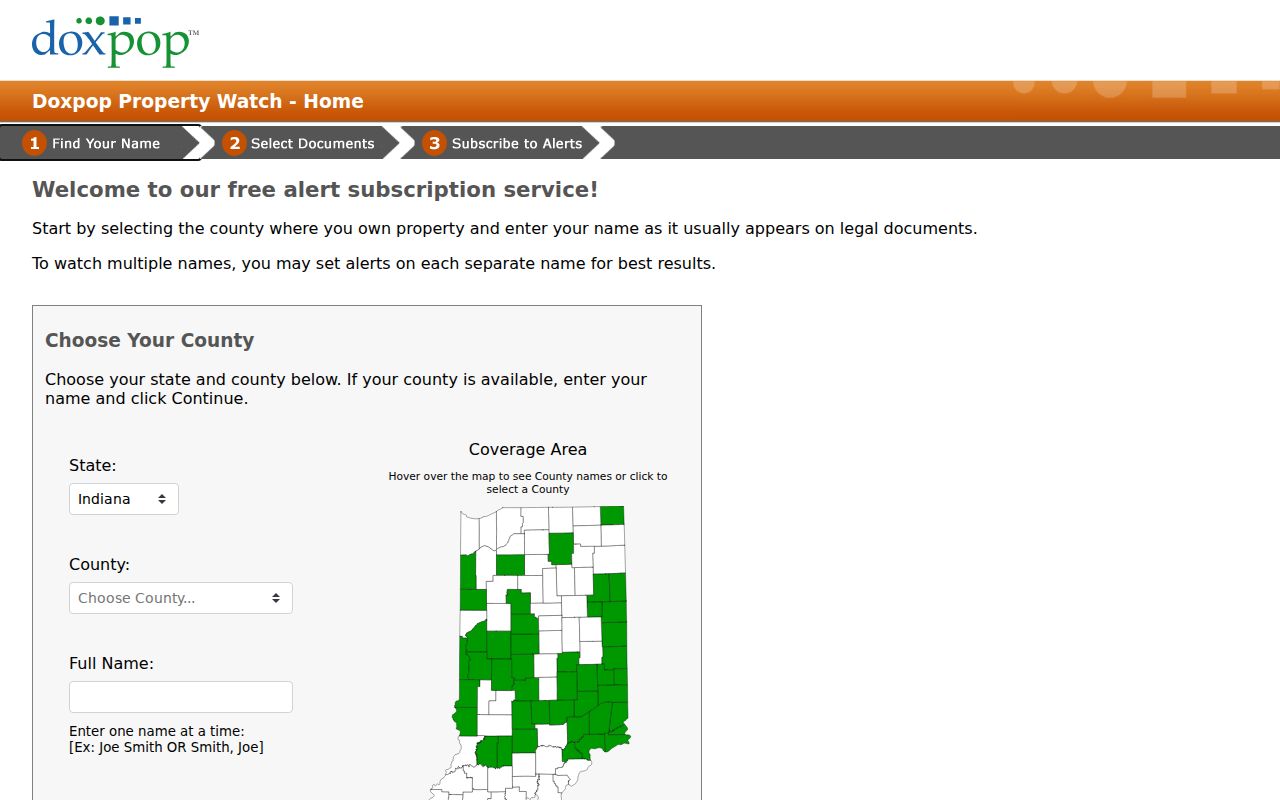
Alerts follow indexed names only. Use the precise deeded name, and consider legitimate variants for a trust or entity. Then investigate any alert through the recorded image itself and the Recorder office rather than the notification alone.
Obtain a Franklin County Deed Copy
Copies carry their own costs. Doxpop may charge for searching, previews, or downloads under its current account and image rates. The Recorder's published schedule prices plain copies up to 11 by 17 inches at $1 per page and certification at $5. Recording fees sit in a separate category. The county schedule lists $25 for deeds and other instruments. That includes UCC and re-recorded instruments. It also lists $55 for mortgages, subordinate mortgages, and re-recorded mortgages. Confirm fees before ordering.
For ordinary research, a portal image or a plain copy from the Recorder serves well. A transaction, court filing, or any matter needing official authentication calls for a certified copy. So identify the instrument precisely. Mail and counter requests should carry contact information. They should also carry enough references for staff to pull the record.
One comparison saves money. Match the index entry against the parcel's legal description. Then check the neighboring entries in the chain before ordering. That step avoids paying for a same-name instrument tied to different land. Note the page count and certification need. Then ask the Recorder which delivery methods are currently available.
A deed copy is not a title opinion. Franklin County's recorded instrument shows what was filed; unrecorded interests, later filings, description conflicts, or legal defects may require a professional title examination.
Note: Execution, recording, portal-data, and tax-roll dates each mark a different step, so compare them instead of treating them as one event.