
Reconstruct Franklin County's Deed Chain Backward
Every deed names two sides. The grantor conveys the interest, and the grantee receives it. To uncover previous owners of a Franklin County parcel, read the newest instrument, then turn its grantor into the next grantee search in the deed records.
- Find the latest purchase or transfer instrument with the present party as grantee.
- Read the grantor and copy the full legal description, dates, and book/page or instrument number.
- Search that grantor as an earlier grantee, then verify the same land description.
- Repeat until 1940, then continue through microfilm index volumes and deed books.
- Grantor and grantee
- The conveying and receiving parties named in an instrument.
- Chain of title
- The ordered sequence of recorded interests in the same land.
- Reverse index
- An index organized to locate a transfer through the party on one side of it.
- Quitclaim and warranty deed
- Different deed forms whose legal effect must be read from the instrument, not assumed from the label.
Use Franklin County Grantor-Grantee Microfilm
The Recorder's published inventory reaches surprisingly far back. Grantor and grantee indexes run through 1902. Deed volumes begin with Volume A at the county system's early starting point. Spans overlap in places, and one alphabetic segment skips J entirely, running H-I,K. Record the exact reel, volume, page, and party spelling. Add the index span and land clue as you go.
For 1902 through 1940, ask the Recorder for help. Ask which index or deed-book segment bridges the online system. For 1811 through 1902, use the listed indexes and volumes. Older context can require later deed recitals. It can also require land patents, neighboring parcels, probate, or records from the earlier county arrangement.
Note: An index points to a deed book. It still does not replace reading the instrument and matching its legal description.
Explain Franklin County's Two Courthouse-Fire Stories
Courthouse-fire lore needs sorting. The State Library reports that Franklin County records survived the 1852 courthouse fire intact. Brookville's official history tells a second story. The 1826 Dearborn County courthouse fire, it says, destroyed early deeds tied to land platted and sold before Franklin County's system was fully established. Both stories can be true. An early Brookville chain may therefore show a soft gap without any failure of Franklin's later deed collection.
Repair the sequence with later deed recitals, the 1811 to 1860 indexes, tax books, probate records, neighboring lots, and the 1882 county atlas. Call an indirect reconstruction evidence, never a certified title opinion.
Translate Old Brookville Lots and Street Names
Brookville's original plat laid out 77 lots in 1808. Franklin County's system did not exist yet. The plat was recorded while the land still belonged to Dearborn County. Another plat and early additions followed in 1812. Street names shifted too. The town history dates a December 1894 change. Named streets such as Bank, Race, James, and Butler gave way to numbers. When an old deed cites a street that no longer appears, use the official Brookville history as a translation lead. Verify the lot in the plat and deed. The local word "bottom" can also point toward a river-side addition. It may not be a modern subdivision name.
For wider context, the 1882 Franklin County plat book places former owners, roads, and farm geography in one view:
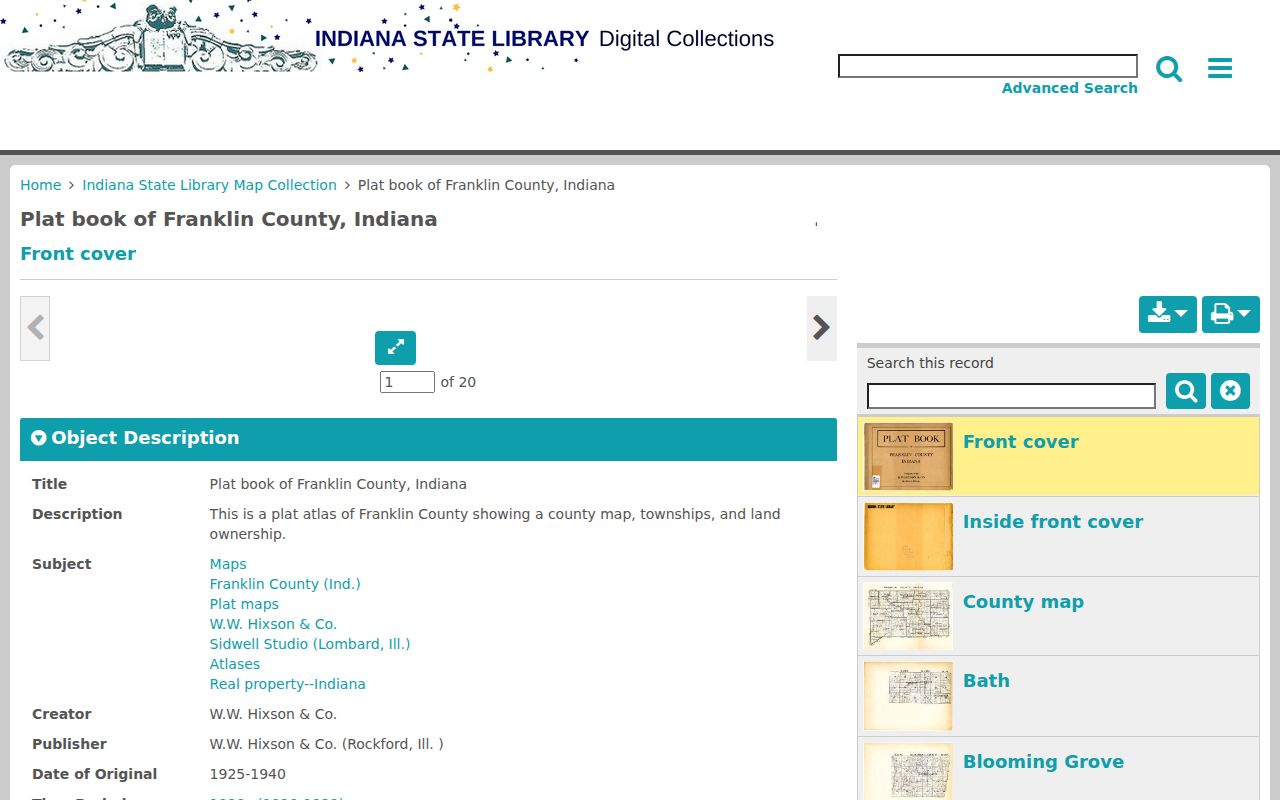
This historic image works as a research bridge. An atlas label is not proof of legal title on a specific date.
Bridge Franklin County Ownership Gaps With Estate Records
A tidy sale-to-sale chain can snap. Land often moved through probate, survivorship, a life estate, a divorce decree, or a personal representative's deed rather than a simple purchase. Search the Recorder for affidavits, decrees, and estate conveyances. Franklin Circuit Court or Indiana MyCase can then surface a public probate or civil case clue. A court party is not automatically an owner. A probate file does not replace the recorded instrument. Compare the court order, the legal description, and the recording date. The county's institutional-property sample pairs life-estate, survivorship-affidavit, and warranty-deed labels together, a reminder that thin tax treatment can hide a tangled transfer trail.
Keep a Franklin County Chain Research Log
Write everything down. For each transfer, capture the essentials. Include names exactly as indexed, execution and recording dates, instrument type, book/page or instrument number, legal description, acreage, source URL or reel, and the next unresolved link. That way your Franklin County chain research stays reproducible.
Newspaper microfilm at the Franklin County Public Library spans 1833 to the present. Estate notices, sheriff's sales, road openings, and subdivision announcements all surface there. Treat those as leads. A deed, plat, court file, city record, or other original source verifies the event.
Need one instrument and copy options? The Franklin County deed records guide covers both. The current roll belongs in the current property owner check.
Take Franklin Former Owners Offline
Access shifts with the year. Modern research starts online. The Recorder remains the route for index clarification, an unavailable image, or certification. Give staff party spellings. Offer an approximate year and a parcel or legal-description clue. Include the last known book/page. The Recorder is not bonded to perform a title search.
The Franklin County Public Library adds newspapers, family files, and vertical material. Such collections can surface an old road or estate notice. They may hold a subdivision event or business name that unlocks an index. Treat them as leads. A deed, probate order, plat, or tax book verifies the land connection.
Online coverage in Franklin County does not start at one common date. Deeds at the Recorder's site reach back to 1940. Mortgages reach 1990. Easements and miscellaneous records reach 1980, while surveys reach 2002. Scanning of every document has been complete since 2001. One cutoff is not the birth of the parcel, and instrument types do not share a single online span.
Brookville renamed its streets in December 1894. Older names such as Bank, Race, James, Claiborne, Walker, Central, Lean, Rose, Grave, John, and Butler gave way to numbered streets. A June 1877 change touched Main, Franklin Avenue, and Central. Translate an old address through the official history first. Then confirm the lot and the legal calls in the plat and the deed itself.
Indiana MyCase can offer a docket clue for a probate, partition, foreclosure, or quiet-title matter. When the online result omits the order or attachment that would explain a transfer, request the public Clerk file. Keep the case number and every party and date variant in your notes. Still, a docket hit never substitutes for the deed, the affidavit, or the certified judgment behind the event.
Pre-1811 and Dearborn-era land calls for a wider net. Federal patents, later deed recitals, probate, tax books, and neighboring parcels all belong in the plan. The Recorder cites instruments dating to 1810, but that claim does not promise that every early instrument survives or appears online. Mark any indirect reconstruction as such. Title conclusions belong to qualified professionals.
A strong log earns its keep in the details. Record each name exactly as indexed. Add execution and recording dates. Include the instrument type and the book/page or instrument number. Note the legal description, acreage, the source URL or microfilm reel, and the next unresolved link. The same log should separate an index entry from the image. It should separate an ordinary image from a certified copy, and a historical lead from an original land record.
Keep the 1826 Dearborn fire and the 1852 Franklin fire distinct. Brookville history reports early Dearborn deed records lost, tied to land sold before Franklin's system took full shape. The State Library states that Franklin County records survived 1852. So an early Brookville gap may demand later recitals and indirect evidence, without implying that later county volumes ever vanished.
Franklin County Library newspaper microfilm runs from 1833 to the present. Estate notices, sheriff's sales, road openings, and subdivision announcements can surface there. The 1882 county plat book adds old roads and landowner geography. Treat both as leads only. Verify each clue against the Recorder or the probate file. Check the plat, the tax book, or another original record before it enters the chain.
Label Franklin County Chain Gaps
Label every gap you leave. An atlas owner label is not a deeded transfer. "Not found online" is not the same as "not recorded." A page may be unreadable. An index spelling may look uncertain. In either case, keep that uncertainty on the record rather than quietly carrying a person into the chain.
Public sources can document the trail with care. Yet they cannot guarantee that every interest or defect has been resolved. A complete legal conclusion may still need a title professional.